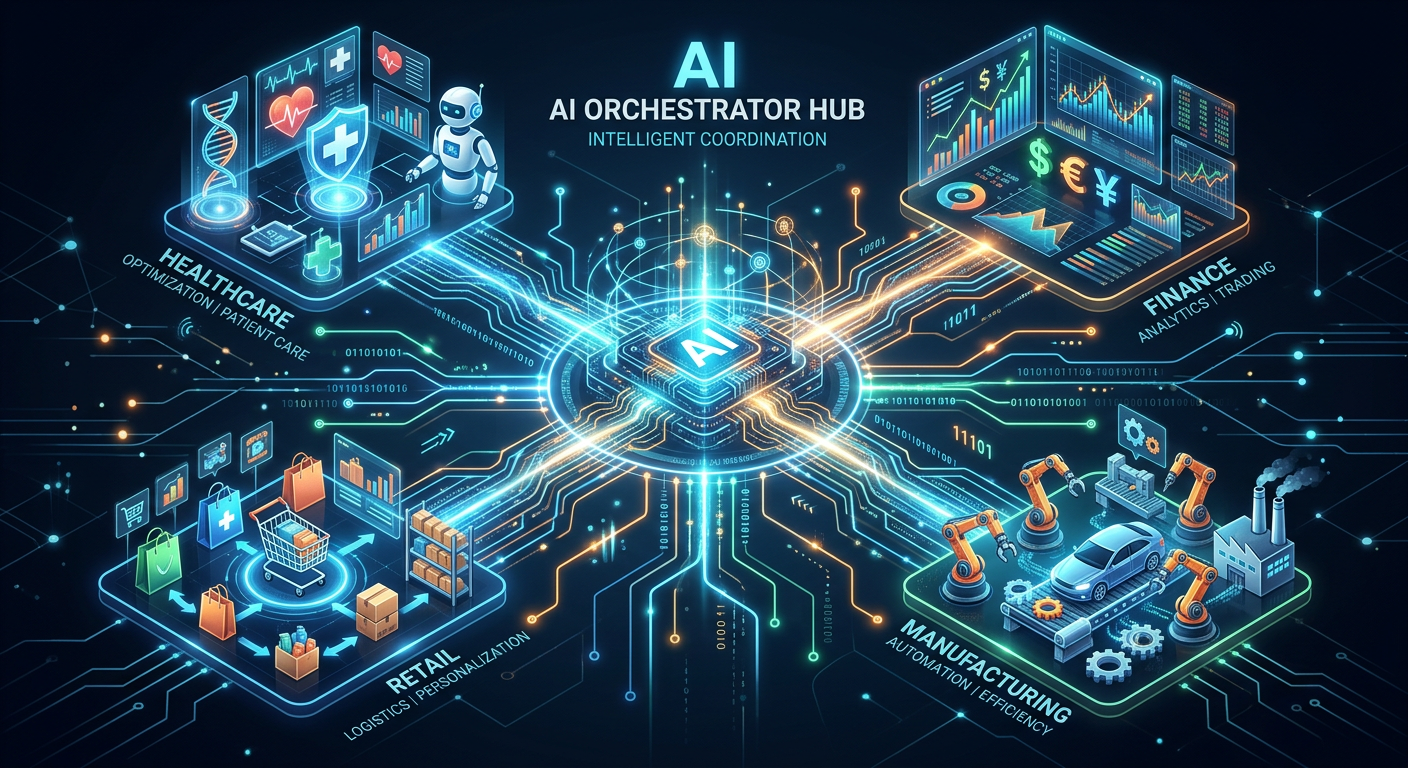
AI Orchestration Use Cases Across Industries
Table of Contents
Across industries, organizations are realizing that the real value of AI does not come from deploying isolated models, but from connecting them into coordinated, accountable workflows that integrate seamlessly with core business systems. Whether in healthcare, finance, retail, manufacturing, customer experience, HR, legal, or revenue operations, the most successful initiatives share common traits: multiple models working together, strong governance and guardrails, clear human oversight at critical decision points, and continuous monitoring for performance and risk. By structuring AI as an interconnected system rather than a collection of tools, companies improve efficiency, strengthen compliance, reduce operational friction, and unlock measurable business impact. For leaders evaluating how to choose an AI orchestration platform, the priority should be building a clear AI orchestration business case—one that demonstrates tangible cost savings, operational resilience, and long-term strategic value.
AI orchestration is the connective tissue that coordinates multiple models, data sources, tools, and workflows into coherent, observable, and governable systems. Instead of a single model responding to a single prompt, you have composed AI systems that call the right model or tool at the right time. These systems route, enrich, and validate data, apply guardrails, policies, and approvals, and integrate directly with your existing data stack.
In this article, we'll explore AI orchestration use cases across eight industries, focusing on how companies are turning raw AI potential into production-grade value. Along the way, we'll ground up the discussion in concrete AI orchestration examples, explain architectural patterns, and highlight where orchestration matters most.
What Is AI Orchestration (In Practical Terms)?
Before any industry is discussed, a working definition should be established. AI orchestration is the layer that coordinates multiple AI components and enterprise systems to deliver end-to-end workflows.
Practically, that means coordinating multiple AI elements like foundation models for language and vision, fine-tuned domain models, traditional ML models for scoring and recommendations, and rules engines or knowledge graphs. These elements must connect with multiple systems, including CRMs, ERPs, EHRs, finance systems, data warehouses, feature stores, and collaboration tools. The goal is to manage this entirely as one productized flow equipped with observability, testing, governance, and versioning. It requires clear SLAs, fallbacks, and human-in-the-loop controls when needed.
Most mature AI orchestration applications include routing to decide which model or tool to call and in what order, alongside on-the-fly data prep for fetching, joining, and normalizing data. They also rely on strict guardrails for policies and PII handling, monitoring performance and hallucinations, and feedback loops that carry insights from end users back into the models. With that lens, this guide examines eight industries where AI orchestration use cases are moving from experiment to core infrastructure.
Healthcare: Orchestrating Data, Models, and Humans [i]
Healthcare is messy: disparate systems, sensitive data, and high stakes outcomes. Yet it's also one of the most promising spaces for AI orchestration, precisely because no single model can safely "do it all."
Story: From Fragmented Data to Actionable Care Plans
Imagine a provider that builds clinical decision support tools for hospital networks. Historically, each hospital runs its own EHR system, uses a patchwork of radiology platforms, stores lab data in yet another system, and has custom rules for alerts. A simple seeming feature like flagging patients at risk of readmission is actually a highly complex workflow. It requires pulling structured data from the EHR, enriching it with lab results, and running a classical ML risk scoring model. From there, an LLM generates a care plan summary, the system checks compliance rules, and the results are presented inside the clinician's existing workflow. Doing this ad hoc for each deployment is painful, making orchestration foundational.
Key Orchestrated Use Cases in Healthcare
For clinical decision to support pipelines, data ingestion from the EHR moves to normalization, passes through a risk-scoring model, and uses an LLM for explanation. Policy engines check local protocols before routing the data to the right clinician based on priority. Orchestration is necessary here to ensure strict traceability of every decision as multiple systems collaborate in real time.
In radiology and imaging workflows, orchestration connects image analysis models, patient histories, and report generation LLMs. It ensures that AI generated findings are safely routed to radiologists for signoff rather than going straight into patient records. Similarly, for patient communication and triage, an intake chatbot collects symptoms, which are fed into a triage model. An LLM then generates plain language advice with strict guardrails, and high-risk cases automatically trigger on-call workflows in tools like PagerDuty. These examples are about making sure all the right systems speak to each other in a reliable, auditable way.
Build Your AI Orchestration Strategy
Hundred Solutions helps enterprise teams design and implement production-grade AI orchestration systems tailored to your industry's compliance and operational needs.
Schedule a Consultation →Finance: Risk, Compliance, and Real-Time Decisions
In financial services, stakes are just as high only the failure modes look different: fraud, regulatory penalties, or reputational damage. AI orchestration in finance is often about balancing speed for real-time decisions, accuracy for risk models, and compliance for audits and controls.
Story: Real-Time Fraud Detection as an Orchestrated Graph
Consider a payments platform serving merchants globally. Each transaction needs to be scored for fraud risk within milliseconds. The platform must personalize thresholds by merchant, geography, and user history while incorporating signals from device fingerprinting and historical graphs to trigger actions like blocking or step-up authentication. A robust orchestration story begins when a transaction enters the orchestrator. Device and network data are fetched asynchronously, a graph ML model is consulted for entity-level risk, and a rules engine applies regional regulatory constraints. An LLM then generates an analyst-friendly explanation for high-risk cases, and the final decision is returned to the transaction pipeline in real time.
Key Orchestrated Use Cases in Finance
Fraud and AML pipelines rely on multiple models like anomaly detection, graph ML, and rules engines, with the orchestrator coordinating features, scoring, and case creation. Credit underwriting combines bureau data, open banking feeds, income verification of APIs, and risk models, ultimately using an LLM to generate lending rationales. Orchestration ensures consistent policy enforcement and auditable decisions throughout this process.
For regulatory reporting and compliance, LLMs and extraction models process contracts and trades while the orchestrator applies region-specific rules, redaction policies, and routes data to compliance teams. These are prime use cases because no single model sees the full picture, requiring a configurable decisioning fabric instead of rigid flows.
Retail & E-Commerce: Personalization at Scale
Retail is where AI hype often starts, but as catalogs grow, channels multiply, and data silos persist; orchestration becomes critical.
From "You May Also Like" to Orchestrated Journeys
A commerce platform powering storefronts for hundreds of brands must deliver personalized homepages, context aware recommendations, dynamic pricing, and consistent omnichannel experiences. Instead of a single recommender for API, the system requires session data from a CDP, semantic search models, collaborative filtering, pricing constraints, and LLMs for dynamic copy. When a user searches, the orchestrator queries vector search, filters by stock and regional restrictions, applies personalization models, and generates copy for product tiles. When sending lifecycle emails, it fetches CRM segments, chooses templates, and uses LLMs to generate personalized messaging within brand guardrails.
Key Orchestrated Use Cases in Retail & E-Commerce
An omnichannel personalization hub uses a central orchestrator to route personalization requests from web, mobile, email, and in-store apps, plugging into multiple models for recommendations and text generation. Dynamic merchandising relies on the orchestrator to balance demand forecasts, inventory levels, category strategies, and customer lifetime value models. Finally, for customer support and order resolution, LLM based agents surface order statuses and personalized offers while the orchestrator handles authentication, PII access, shipping system calls, and escalation rules.
Manufacturing & Industry 4.0: From Sensors to Decisions
Manufacturing environments generate enormous data from IoT sensors, maintenance logs, ERPs, and supply chain systems. Orchestration provides the connective tissue between operational technology and IT.
Story: Predictive Maintenance as an Orchestrated Loop
To move beyond static dashboards, a predictive maintenance vendor needs to continuously ingest sensor streams, run anomaly detection models, correlate anomalies with maintenance history, generate recommended actions, and open tickets in maintenance systems. Without orchestration, these are disconnected scripts. With orchestration, a central engine coordinates ingestion and scoring, LLMs generate natural language work orders based on model outputs, and the system seamlessly routes tasks according to plant, shift, and skill profiles.
Key Orchestrated Use Cases in Manufacturing
Predictive maintenance pipelines orchestrate time-series ML models, event processing, and ticketing integrations. For quality control, vision models detect defects on production lines while the orchestrator correlates this with batch data and supplier info to trigger line adjustments automatically. Supply chain optimization combines demand forecasts, lead-time models, and cost algorithms, utilizing LLMs to summarize risk scenarios for planners.
Customer Experience & Contact Centers: The "Swiss Army Knife" Domain
Contact centers are already acting as mainstream hubs for orchestration, serving as a unified intelligence layer across all channels.
Story: A Unified Support Brain Across Channels
A global company wanting a single intelligence layer for chat, voice support, tier-1 automation, agent assist, and knowledge base management cannot rely on a monolithic bot. Instead, an intake layer transcribes or parses requests, a classifier routes intent, and the orchestrator decides if the issue can be automated, requires an agent, or relates to billing. For automated flows, it calls an LLM to draft responses, connects to billing APIs, and applies compliance guardrails. For assisted flows, it provides live agents with suggested responses and surfaces relevant KB articles.
Key Orchestrated Use Cases in CX & Contact Centers
A unified virtual agent across channels shares an orchestration layer for chat, email, and voice to maintain consistent logic and policies. Agent assist workflows orchestrate LLMs for live suggestions, automatic summarization, and CRM updates. For quality assurance and coaching, speech and text models evaluate calls while the orchestrator routes low-score instances to supervisors and generates actionable feedback.
HR & Talent: Orchestrating People, Policies, and Data
HR deals with complex, sensitive data spanning ATS, HRIS, and payroll systems. Orchestration is essential for safe and compliant AI usage.
Story: Fair Hiring at Scale, Not Just Faster Hiring
An HR provider wanting to use AI to assist recruiters without introducing bias must screen resumes, enrich profiles from public data, suggest matches, and draft outreach. To do this well, they orchestrate the ingestion of resumes from the ATS, run debiasing routines, apply recommendation models for fit scoring, check policies for equal-opportunity compliance, and use LLMs for outreach templates that recruiters can manually review.
Key Orchestrated Use Cases in HR & Talent
Candidate screening pipelines orchestrate parsing, enrichment, scoring, and compliance checks while keeping human-in-the-loop control for recruiters. Employee development workflows match staff to roles and learning paths by orchestrating skills ontologies, performance data, and course catalogs. For policy management, LLMs answer HR questions while the orchestrator enforces access controls and redactions to protect sensitive data.
Legal & Compliance: AI That Doesn't Become a Liability
Legal workflows are ideal for AI augmentation but demand rigorous control to ensure models never operate in an uncontrolled vacuum.
Story: Contract Review with Multiple Expert "Agents"
Accelerating contract review for legal teams requires a panel of specialized components rather than one super model. This includes clause extraction models, risk scoring, summarization LLMs, rule-based checklists, and redaction tools. The AI orchestrator splits contracts into logical sections, assigns each to the relevant models, aggregates the outputs into a unified view, applies playbook rules for risk flags, and generates an executive summary with suggested redlines.
Key Orchestrated Use Cases in Legal & Compliance
Contract Lifecycle Management involves drafting assistance and clause comparison by orchestrating multiple models alongside DMS and eSignature tools. Regulatory monitoring uses LLMs to process updates from regulators while the orchestrator matches these changes to internal policies and routes tasks to owners. eDiscovery relies on search, clustering, and summarization models working in tandem, with the orchestrator maintaining chain of custody, access control, and audit logs.
Marketing & Sales Operations: Composable GTM Engines [ii]
Adding AI to heavily integrated marketing and sales stacks without orchestration just introduces islands of automation. The real opportunity is a composable engine.
Story: A Revenue Orchestration Fabric
To orchestrate the entire revenue motion from lead routing to forecasting, a platform builds an orchestrated layer instead of isolated tools. This layer pulls data from CRMs and product analytics, feeds signals into lead scoring models, uses LLMs to draft personalized sequences, routes insights back into collaboration tools, and continuously learns from conversion outcomes.
Key Orchestrated Use Cases in Marketing & Sales
Lead and account scoring pipelines ingest behavioral and firmographic data, orchestrating multiple scoring models and business rules. Personalized campaign automation uses LLMs to generate content variants while the orchestrator enforces brand guidelines and GDPR compliance. Sales copilots aggregate signals across systems into daily briefings for reps by orchestrating summarization, recommendation, and forecasting models.
Common Patterns Across AI Orchestration Use Cases
Across all eight industries, similar architectural and product patterns emerge.
- Multi-modal, Multi-Tool Coordination: Every serious deployment uses multiple AI models like LLMs, ML, and vision, alongside enterprise tools like CRMs and custom APIs. Orchestration chooses exactly which model or tool to call, in what specific sequence, and under what constraints.
- Governance and Guardrails by Design: Governance is non-negotiable. This means enforcing role-based access, practicing data minimization, logging every single call and decision, executing redaction and anonymization, and maintaining strict audit trails for regulators.
- Human in the Loop at Critical Points: Orchestration smartly determines where humans must enter the loop. This includes scenarios like approving AI-generated recommendations, overriding or confirming critical decisions, and providing qualitative feedback that subsequently updates policies or models.
- Observability and Continuous Improvement: Mature orchestration applications treat AI like any other critical system. They track performance metrics like latency and cost, quality metrics like accuracy and safety, facilitate A/B testing for different flows, and maintain automated rollbacks and fallbacks.
What This Means for Builders
The strategic question is no longer whether to use AI, but rather how to compose AI, data, and workflows into reliable products. Teams must figure out how to differentiate when everyone uses similar foundation models and how to govern AI so it scales across enterprise customers.
The answer is an orchestration-first mindset. By focusing on orchestration use cases specific to your vertical, you can turn fragmented models into cohesive products. This allows you to build defensible value in the orchestration logic itself and meet enterprise expectations for reliability, compliance, and extensibility.
FAQs on AI Orchestration
AI orchestration is a coordination layer that manages multiple models, tools, and workflows end-to-end, whereas calling a single AI API is just a point integration. Orchestration physically routes between multiple tools, manages context, enforces strict guardrails, and observes performance over time. Most real-world workflows cannot be solved with a single API call; they require composed, conditional flows.
In early prototypes, you might not. But in production scenarios, you will quickly need different models for specialized tasks like classification or retrieval, routing between providers for cost or regional compliance, and deep integration with customer data tools. Designing with orchestration in mind makes your system modular and future-proof from day one.
Compliance in these sectors is all about control and traceability. Orchestration allows you to strictly control what data each model sees, enforce PII handling and regional rules, log every step in a complex decision flow, and provide explainable outputs for auditors. It centralizes these concerns instead of scattering them across one-off integrations.
Great starter patterns include customer support triage to classify and route across channels, document intake to extract and store forms, lead routing based on multiple signals, and risk alerts that aggregate model outputs and apply thresholds. These are contained use cases that deliver immediate, clear business value.
MLOps platforms typically handle model training, deployment, feature stores, and experiment tracking. Orchestration sits comfortably above this layer. It decides which models to call, chains them together, integrates them with LLMs and rules engines, and provides a workflow-centric view rather than a model-centric view. MLOps manages the models, while orchestration composes those models into a usable product.
A pragmatic approach starts by identifying one high-impact workflow with clear owners and metrics. Map the end-to-end journey including inputs, decisions, and human touchpoints. Next, list the required components like existing ML models and data systems, design the orchestrated flow with decision points and fallbacks, and ensure you instrument for observability from day one.
AI Orchestration Use Cases Across Industries
Table of Contents
Across industries, organizations are realizing that the real value of AI does not come from deploying isolated models, but from connecting them into coordinated, accountable workflows that integrate seamlessly with core business systems. Whether in healthcare, finance, retail, manufacturing, customer experience, HR, legal, or revenue operations, the most successful initiatives share common traits: multiple models working together, strong governance and guardrails, clear human oversight at critical decision points, and continuous monitoring for performance and risk. By structuring AI as an interconnected system rather than a collection of tools, companies improve efficiency, strengthen compliance, reduce operational friction, and unlock measurable business impact. For leaders evaluating how to choose an AI orchestration platform, the priority should be building a clear AI orchestration business case—one that demonstrates tangible cost savings, operational resilience, and long-term strategic value.
AI orchestration is the connective tissue that coordinates multiple models, data sources, tools, and workflows into coherent, observable, and governable systems. Instead of a single model responding to a single prompt, you have composed AI systems that call the right model or tool at the right time. These systems route, enrich, and validate data, apply guardrails, policies, and approvals, and integrate directly with your existing data stack.
In this article, we'll explore AI orchestration use cases across eight industries, focusing on how companies are turning raw AI potential into production-grade value. Along the way, we'll ground up the discussion in concrete AI orchestration examples, explain architectural patterns, and highlight where orchestration matters most.
What Is AI Orchestration (In Practical Terms)?
Before any industry is discussed, a working definition should be established. AI orchestration is the layer that coordinates multiple AI components and enterprise systems to deliver end-to-end workflows.
Practically, that means coordinating multiple AI elements like foundation models for language and vision, fine-tuned domain models, traditional ML models for scoring and recommendations, and rules engines or knowledge graphs. These elements must connect with multiple systems, including CRMs, ERPs, EHRs, finance systems, data warehouses, feature stores, and collaboration tools. The goal is to manage this entirely as one productized flow equipped with observability, testing, governance, and versioning. It requires clear SLAs, fallbacks, and human-in-the-loop controls when needed.
Most mature AI orchestration applications include routing to decide which model or tool to call and in what order, alongside on-the-fly data prep for fetching, joining, and normalizing data. They also rely on strict guardrails for policies and PII handling, monitoring performance and hallucinations, and feedback loops that carry insights from end users back into the models. With that lens, this guide examines eight industries where AI orchestration use cases are moving from experiment to core infrastructure.
Healthcare: Orchestrating Data, Models, and Humans [i]
Healthcare is messy: disparate systems, sensitive data, and high stakes outcomes. Yet it's also one of the most promising spaces for AI orchestration, precisely because no single model can safely "do it all."
Story: From Fragmented Data to Actionable Care Plans
Imagine a provider that builds clinical decision support tools for hospital networks. Historically, each hospital runs its own EHR system, uses a patchwork of radiology platforms, stores lab data in yet another system, and has custom rules for alerts. A simple seeming feature like flagging patients at risk of readmission is actually a highly complex workflow. It requires pulling structured data from the EHR, enriching it with lab results, and running a classical ML risk scoring model. From there, an LLM generates a care plan summary, the system checks compliance rules, and the results are presented inside the clinician's existing workflow. Doing this ad hoc for each deployment is painful, making orchestration foundational.
Key Orchestrated Use Cases in Healthcare
For clinical decision to support pipelines, data ingestion from the EHR moves to normalization, passes through a risk-scoring model, and uses an LLM for explanation. Policy engines check local protocols before routing the data to the right clinician based on priority. Orchestration is necessary here to ensure strict traceability of every decision as multiple systems collaborate in real time.
In radiology and imaging workflows, orchestration connects image analysis models, patient histories, and report generation LLMs. It ensures that AI generated findings are safely routed to radiologists for signoff rather than going straight into patient records. Similarly, for patient communication and triage, an intake chatbot collects symptoms, which are fed into a triage model. An LLM then generates plain language advice with strict guardrails, and high-risk cases automatically trigger on-call workflows in tools like PagerDuty. These examples are about making sure all the right systems speak to each other in a reliable, auditable way.
Build Your AI Orchestration Strategy
Hundred Solutions helps enterprise teams design and implement production-grade AI orchestration systems tailored to your industry's compliance and operational needs.
Schedule a Consultation →Finance: Risk, Compliance, and Real-Time Decisions
In financial services, stakes are just as high only the failure modes look different: fraud, regulatory penalties, or reputational damage. AI orchestration in finance is often about balancing speed for real-time decisions, accuracy for risk models, and compliance for audits and controls.
Story: Real-Time Fraud Detection as an Orchestrated Graph
Consider a payments platform serving merchants globally. Each transaction needs to be scored for fraud risk within milliseconds. The platform must personalize thresholds by merchant, geography, and user history while incorporating signals from device fingerprinting and historical graphs to trigger actions like blocking or step-up authentication. A robust orchestration story begins when a transaction enters the orchestrator. Device and network data are fetched asynchronously, a graph ML model is consulted for entity-level risk, and a rules engine applies regional regulatory constraints. An LLM then generates an analyst-friendly explanation for high-risk cases, and the final decision is returned to the transaction pipeline in real time.
Key Orchestrated Use Cases in Finance
Fraud and AML pipelines rely on multiple models like anomaly detection, graph ML, and rules engines, with the orchestrator coordinating features, scoring, and case creation. Credit underwriting combines bureau data, open banking feeds, income verification of APIs, and risk models, ultimately using an LLM to generate lending rationales. Orchestration ensures consistent policy enforcement and auditable decisions throughout this process.
For regulatory reporting and compliance, LLMs and extraction models process contracts and trades while the orchestrator applies region-specific rules, redaction policies, and routes data to compliance teams. These are prime use cases because no single model sees the full picture, requiring a configurable decisioning fabric instead of rigid flows.
Retail & E-Commerce: Personalization at Scale
Retail is where AI hype often starts, but as catalogs grow, channels multiply, and data silos persist; orchestration becomes critical.
From "You May Also Like" to Orchestrated Journeys
A commerce platform powering storefronts for hundreds of brands must deliver personalized homepages, context aware recommendations, dynamic pricing, and consistent omnichannel experiences. Instead of a single recommender for API, the system requires session data from a CDP, semantic search models, collaborative filtering, pricing constraints, and LLMs for dynamic copy. When a user searches, the orchestrator queries vector search, filters by stock and regional restrictions, applies personalization models, and generates copy for product tiles. When sending lifecycle emails, it fetches CRM segments, chooses templates, and uses LLMs to generate personalized messaging within brand guardrails.
Key Orchestrated Use Cases in Retail & E-Commerce
An omnichannel personalization hub uses a central orchestrator to route personalization requests from web, mobile, email, and in-store apps, plugging into multiple models for recommendations and text generation. Dynamic merchandising relies on the orchestrator to balance demand forecasts, inventory levels, category strategies, and customer lifetime value models. Finally, for customer support and order resolution, LLM based agents surface order statuses and personalized offers while the orchestrator handles authentication, PII access, shipping system calls, and escalation rules.
Manufacturing & Industry 4.0: From Sensors to Decisions
Manufacturing environments generate enormous data from IoT sensors, maintenance logs, ERPs, and supply chain systems. Orchestration provides the connective tissue between operational technology and IT.
Story: Predictive Maintenance as an Orchestrated Loop
To move beyond static dashboards, a predictive maintenance vendor needs to continuously ingest sensor streams, run anomaly detection models, correlate anomalies with maintenance history, generate recommended actions, and open tickets in maintenance systems. Without orchestration, these are disconnected scripts. With orchestration, a central engine coordinates ingestion and scoring, LLMs generate natural language work orders based on model outputs, and the system seamlessly routes tasks according to plant, shift, and skill profiles.
Key Orchestrated Use Cases in Manufacturing
Predictive maintenance pipelines orchestrate time-series ML models, event processing, and ticketing integrations. For quality control, vision models detect defects on production lines while the orchestrator correlates this with batch data and supplier info to trigger line adjustments automatically. Supply chain optimization combines demand forecasts, lead-time models, and cost algorithms, utilizing LLMs to summarize risk scenarios for planners.
Customer Experience & Contact Centers: The "Swiss Army Knife" Domain
Contact centers are already acting as mainstream hubs for orchestration, serving as a unified intelligence layer across all channels.
Story: A Unified Support Brain Across Channels
A global company wanting a single intelligence layer for chat, voice support, tier-1 automation, agent assist, and knowledge base management cannot rely on a monolithic bot. Instead, an intake layer transcribes or parses requests, a classifier routes intent, and the orchestrator decides if the issue can be automated, requires an agent, or relates to billing. For automated flows, it calls an LLM to draft responses, connects to billing APIs, and applies compliance guardrails. For assisted flows, it provides live agents with suggested responses and surfaces relevant KB articles.
Key Orchestrated Use Cases in CX & Contact Centers
A unified virtual agent across channels shares an orchestration layer for chat, email, and voice to maintain consistent logic and policies. Agent assist workflows orchestrate LLMs for live suggestions, automatic summarization, and CRM updates. For quality assurance and coaching, speech and text models evaluate calls while the orchestrator routes low-score instances to supervisors and generates actionable feedback.
HR & Talent: Orchestrating People, Policies, and Data
HR deals with complex, sensitive data spanning ATS, HRIS, and payroll systems. Orchestration is essential for safe and compliant AI usage.
Story: Fair Hiring at Scale, Not Just Faster Hiring
An HR provider wanting to use AI to assist recruiters without introducing bias must screen resumes, enrich profiles from public data, suggest matches, and draft outreach. To do this well, they orchestrate the ingestion of resumes from the ATS, run debiasing routines, apply recommendation models for fit scoring, check policies for equal-opportunity compliance, and use LLMs for outreach templates that recruiters can manually review.
Key Orchestrated Use Cases in HR & Talent
Candidate screening pipelines orchestrate parsing, enrichment, scoring, and compliance checks while keeping human-in-the-loop control for recruiters. Employee development workflows match staff to roles and learning paths by orchestrating skills ontologies, performance data, and course catalogs. For policy management, LLMs answer HR questions while the orchestrator enforces access controls and redactions to protect sensitive data.
Legal & Compliance: AI That Doesn't Become a Liability
Legal workflows are ideal for AI augmentation but demand rigorous control to ensure models never operate in an uncontrolled vacuum.
Story: Contract Review with Multiple Expert "Agents"
Accelerating contract review for legal teams requires a panel of specialized components rather than one super model. This includes clause extraction models, risk scoring, summarization LLMs, rule-based checklists, and redaction tools. The AI orchestrator splits contracts into logical sections, assigns each to the relevant models, aggregates the outputs into a unified view, applies playbook rules for risk flags, and generates an executive summary with suggested redlines.
Key Orchestrated Use Cases in Legal & Compliance
Contract Lifecycle Management involves drafting assistance and clause comparison by orchestrating multiple models alongside DMS and eSignature tools. Regulatory monitoring uses LLMs to process updates from regulators while the orchestrator matches these changes to internal policies and routes tasks to owners. eDiscovery relies on search, clustering, and summarization models working in tandem, with the orchestrator maintaining chain of custody, access control, and audit logs.
Marketing & Sales Operations: Composable GTM Engines [ii]
Adding AI to heavily integrated marketing and sales stacks without orchestration just introduces islands of automation. The real opportunity is a composable engine.
Story: A Revenue Orchestration Fabric
To orchestrate the entire revenue motion from lead routing to forecasting, a platform builds an orchestrated layer instead of isolated tools. This layer pulls data from CRMs and product analytics, feeds signals into lead scoring models, uses LLMs to draft personalized sequences, routes insights back into collaboration tools, and continuously learns from conversion outcomes.
Key Orchestrated Use Cases in Marketing & Sales
Lead and account scoring pipelines ingest behavioral and firmographic data, orchestrating multiple scoring models and business rules. Personalized campaign automation uses LLMs to generate content variants while the orchestrator enforces brand guidelines and GDPR compliance. Sales copilots aggregate signals across systems into daily briefings for reps by orchestrating summarization, recommendation, and forecasting models.
Common Patterns Across AI Orchestration Use Cases
Across all eight industries, similar architectural and product patterns emerge.
- Multi-modal, Multi-Tool Coordination: Every serious deployment uses multiple AI models like LLMs, ML, and vision, alongside enterprise tools like CRMs and custom APIs. Orchestration chooses exactly which model or tool to call, in what specific sequence, and under what constraints.
- Governance and Guardrails by Design: Governance is non-negotiable. This means enforcing role-based access, practicing data minimization, logging every single call and decision, executing redaction and anonymization, and maintaining strict audit trails for regulators.
- Human in the Loop at Critical Points: Orchestration smartly determines where humans must enter the loop. This includes scenarios like approving AI-generated recommendations, overriding or confirming critical decisions, and providing qualitative feedback that subsequently updates policies or models.
- Observability and Continuous Improvement: Mature orchestration applications treat AI like any other critical system. They track performance metrics like latency and cost, quality metrics like accuracy and safety, facilitate A/B testing for different flows, and maintain automated rollbacks and fallbacks.
What This Means for Builders
The strategic question is no longer whether to use AI, but rather how to compose AI, data, and workflows into reliable products. Teams must figure out how to differentiate when everyone uses similar foundation models and how to govern AI so it scales across enterprise customers.
The answer is an orchestration-first mindset. By focusing on orchestration use cases specific to your vertical, you can turn fragmented models into cohesive products. This allows you to build defensible value in the orchestration logic itself and meet enterprise expectations for reliability, compliance, and extensibility.
FAQs on AI Orchestration
AI orchestration is a coordination layer that manages multiple models, tools, and workflows end-to-end, whereas calling a single AI API is just a point integration. Orchestration physically routes between multiple tools, manages context, enforces strict guardrails, and observes performance over time. Most real-world workflows cannot be solved with a single API call; they require composed, conditional flows.
In early prototypes, you might not. But in production scenarios, you will quickly need different models for specialized tasks like classification or retrieval, routing between providers for cost or regional compliance, and deep integration with customer data tools. Designing with orchestration in mind makes your system modular and future-proof from day one.
Compliance in these sectors is all about control and traceability. Orchestration allows you to strictly control what data each model sees, enforce PII handling and regional rules, log every step in a complex decision flow, and provide explainable outputs for auditors. It centralizes these concerns instead of scattering them across one-off integrations.
Great starter patterns include customer support triage to classify and route across channels, document intake to extract and store forms, lead routing based on multiple signals, and risk alerts that aggregate model outputs and apply thresholds. These are contained use cases that deliver immediate, clear business value.
MLOps platforms typically handle model training, deployment, feature stores, and experiment tracking. Orchestration sits comfortably above this layer. It decides which models to call, chains them together, integrates them with LLMs and rules engines, and provides a workflow-centric view rather than a model-centric view. MLOps manages the models, while orchestration composes those models into a usable product.
A pragmatic approach starts by identifying one high-impact workflow with clear owners and metrics. Map the end-to-end journey including inputs, decisions, and human touchpoints. Next, list the required components like existing ML models and data systems, design the orchestrated flow with decision points and fallbacks, and ensure you instrument for observability from day one.

AI Orchestration Use Cases: 8 Industries Transforming with Orchestration